


Page 86 - Shashwat - Restoring Green Economy
P. 86
Feature


                                84


             Financing Low Carbon


             Transitions in India


                                             Introduction                   Global Climate Risk Index, 2021.
             India is the fourth highest emitter   Climate change is the most common   The effects of climate change are
                                                                            already visible in terms of changes in
             of CO  in the world. In this    cause of disasters–both natural
                  2                                                         rainfall patterns, high temperatures,
             timely article, Gaurav VarshneyGaurav Varshney   and human-induced–the world is   increase in sea level, and frequent
             looks at low carbon transitions   grappling with today. India is one   occurrences of cyclones, storms, and
             from a financial perspective to   of the most vulnerable countries   landslides. According to the latest
             understand the feasibility of   to climate change risks, and ranks   Intergovernmental Panel on Climate
             various financial instruments,   seventh worldwide in the Global   Change (IPCC) report published in
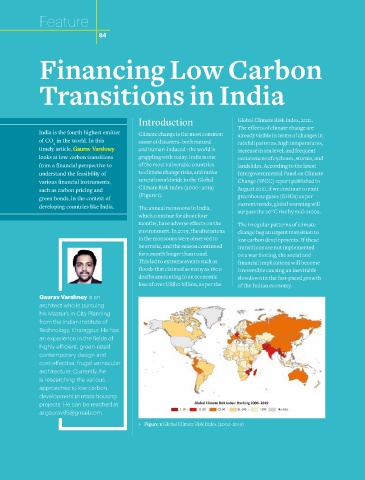
             such as carbon pricing and      Climate Risk Index (2000–2019)    August 2021, if we continue to emit
             green bonds, in the context of   (Figure 1).                   greenhouse gases (GHGs) as per
             developing countries like India.  The annual monsoons in India,   current trends, global warming will
                                             which continue for about four   surpass the 20°C rise by mid-2100s.
                                             months, have adverse effects on the   The irregular patterns of climate
                                             environment. In 2019, the alterations   change beg an urgent transition to
                                             in the monsoons were observed to   low carbon developments. If these
                                             be erratic, and the season continued   transitions are not implemented
                                             for a month longer than usual.   on a war footing, the social and
                                             This led to extreme events such as   financial implications will become
                                             floods that claimed as many as 1800   irreversible causing an inevitable
                                             deaths amounting to an economic   slowdown in the fast-paced growth
                                             loss of over US$10 billion, as per the   of the Indian economy.

             Gaurav Varshney is an
             architect who is pursuing
             his Master’s in City Planning
             from the Indian Institute of
             Technology, Kharagpur. He has
             an experience in the fields of
             highly efficient, green-rated
             contemporary design and
             cost-effective, frugal vernacular
             architecture. Currently, he
             is researching the various
             approaches to low carbon
             development in mass housing
             projects. He can be reached at                   Global Climate Risk Index: Ranking 2000- 2019
             ar.gaurav95@gmail.com.                       1-10  11-20  21-50  51-100  >100  No data

                                               » Figure 1: Global Climate Risk Index (2000–2019)

